
By: Abhinav Malhotra, Bureau Chief ICN Punjab & Corporate Brand Manager ZDL Zodiacal Pharmaceutics Pvt Ltd
Blending traditional and contemporary approach towards Life and Work
CHANDIGARH : A former United States Senator Byron L Dorgan quoted “Working Hard and working Smart sometimes can be two different things”
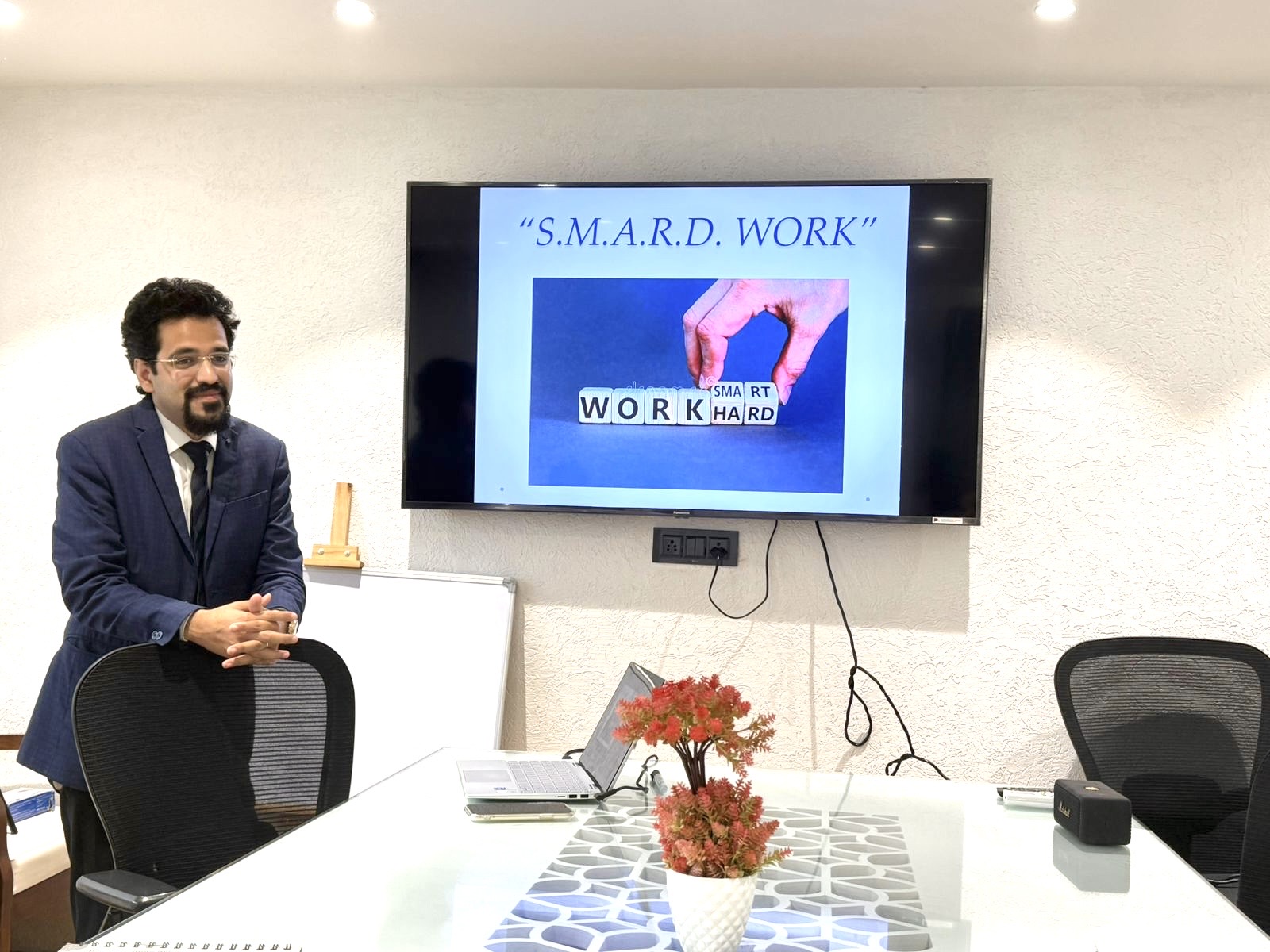
Well in my attempt to blend the two together, a portmanteau named “SMARD” was coined.
Often, we come across famous quotes from the past where hard work was glorified and considered to be the only secret recipe for success. We were wired to believe that hard work brings laurels while the lack of it will wreck your present and certainly your future. The concept of smart work emerged in conversations as technology became an integral part of our daily lives. Anything that saved time, minimized expenses or conserved energy was blatantly quoted as a smart move.
Hence, the concept of SMARD Work was created after intense contemplation and rigorous on-ground work of over a decade where I made an ingenuous attempt to blend the concepts of Smart and Hard Work while maintaining the sanctity of each term as an individual.
Let us dive a little deep into the concept with sleek explanations and evince the importance of each alphabet.
S: Simple and Systematic
When things are lined up in a chronological manner from morning to evening, you don’t need to struggle and manage tasks even if you are having a bad day at work.
The modern-day employee is not looking for gimmicks and word plays. A manager who simplifies his colleagues work and systematically manages tasks is often more productive and even loved, rather than the one who complicates simple situations and creates undue pressure.
Additionally, we need to utilize the resources available to us in a more pragmatic manner. Put your smartphone to better use. Use the notes and To- Do Lists sections appropriately. Jot down important tasks with specific timings. For those of you using an iPhone, the TO DO List automatically picks dates from the calendar while you schedule an event. The concept of keeping a Pocket Diary is again a very underrated yet valuable approach.
M : Mesurable
In Business Terminology: ROE = Benefit Achieved / Time Invested Every extra 10 hours that you put in a project will result in an increase of
Rs.10,000 Revenue. Hence, the ROE will be Rs.1,000 Per Hour. Taking a simple example of a marketing professional who often travels forwork, the working hours or days are usually counted for the period when he reaches his work destination and the length he stays there. Often, what is ignored is the EFFORT that was required prior to the actual working day. We can note the following things that were done a day or two before the visit:
1. Checking and noting the sales position of the Area that is to be visited.
2. Packing own stuff and accessories required for Travel.
3. Managing inputs required by the team.
4. Booking travel tickets and accommodation.
The list can go on to eternity, but the point being highlighted here is that prior to the actual working day, there are a number of tasks that need to be managed in order to make that visit successful the next day. Those tasks often lead to situations where we are compulsively bound to compromise our family time. Such parameters are not counted anywhere in the primitive ROE.
Hence, when we talk about S.M.A.R.D approach towards work, we not only count numbers but also analyze and measure the effort involved in each task. A person following the S.M.A.R.D approach understands the importance of both qualitative as well as quantitative factors. We need to analyse each micro parameter, may it be the compromised personal time or the delicious meal that we missed.
Measure your efforts, and your work gets measured.
A: Analytical
There is no space for boring, numb and dumb Gyaan (knowledge) for the upcoming generations. They are looking for quick and solution- oriented tasks.These sharp minds are paradoxically judging their own mentors most of the time.
Using our Analytical thinking skills, we should put forward solutions that have a long-lasting impact on our students / peers / colleagues. The young minds out there are extremely good at their numbers game. They need to be taught and trained using statistics and data that intrigues them.
Further, while approaching work in the 21 st Century, we need to understand that vague statements and stories with no numbers or statistics are never weighed equally to the ones that have an analytical approach. It might be a father trying to convince his son to take up medicine as a career, stating the salary figures and perks attached, or a manager motivating the new recruit by citing incentives and emoluments involved.
R: Relatable
A motivational speaker based in Chandigarh humorously narrated an incident a corporate event, where he mentioned that his son loved History out of all the subjects. Considering the general perception around History being a non- interesting subject, he decided to attend the upcoming Parent-teacher meeting of the school to find out the reason. He later mentioned that the History teacher was extremely beautiful with a charming persona, and hence he could absolutely relate why his son had an inclination towards the subject.
Well, the above example presents a fraction of the entire concept. Another relevant example of Relatability can be anchored to Standup Comedy, which has become a multibillion-dollar industry. Comedians often resort to humor with which the audience as a whole can relate. Cracking jokes on the daily struggles at the workplace to silly fights between couples at home, the audience often feels as if the Joke was absolutely on point and could relate toeach situation as narrated by the comedian.
The same is applicable when we talk of managing the modern field force. Often in my own organization, I come across situations where my subordinate is highly demotivated due to some external influence and the impact is clear on the sales figures. Now instead of lambasting him, first the influence has to be understood and the corollary action has to be decided accordingly. Often, I counter this situation with real life examples as to how my own mentor guided me through a similar problem. Creating a relatability factor that I overcame a similar problem becomes a turning point in the conversation where he is made to believe that if my senior could do it, why can’t I?
D: Dependence (Dependable)
An intricate thing that I have observed and rather implemented in my 11 years of experience is that dependence has to be a two-way process. The subordinate is usually dependent on his senior for a plethora of tasks, but the twist in the tale arises when we notice that if we make our subordinate feel that we are dependent on him for some specific tasks. This might just be the game-changer where the subordinate feels important and valued.
For this, we need to understand the theory of X and Y in a succinct manner, developed by Douglas McGregor in the 1960’s, where he mentioned that people who inherently dislike work and consider it to be a burden fall in category X, and the people who are inclined and naturally motivated to work, fall in the Y category. People in X category need to be dealt in the Authoritarian management style where as people in Y Category can be dealt with the participative management style and a decentralized approach.
People who fall in category Y can surely be those who will feel valued if given a set of work that they know is only their responsibility. Here, the paradoxical concept of dependence on a subordinate can fit in well.
Hence concluding here, we cannot claim S.M.A.R.D to be some form of Incantation, but can surely promulgate its pragmatic nature in managing personal as well as professional lives. If S.M.A.R.D approach turns out to be the bellwether for reforms in management techniques, maybe we can create a healthy blend of the traditional ones while not compromising the modern practices.