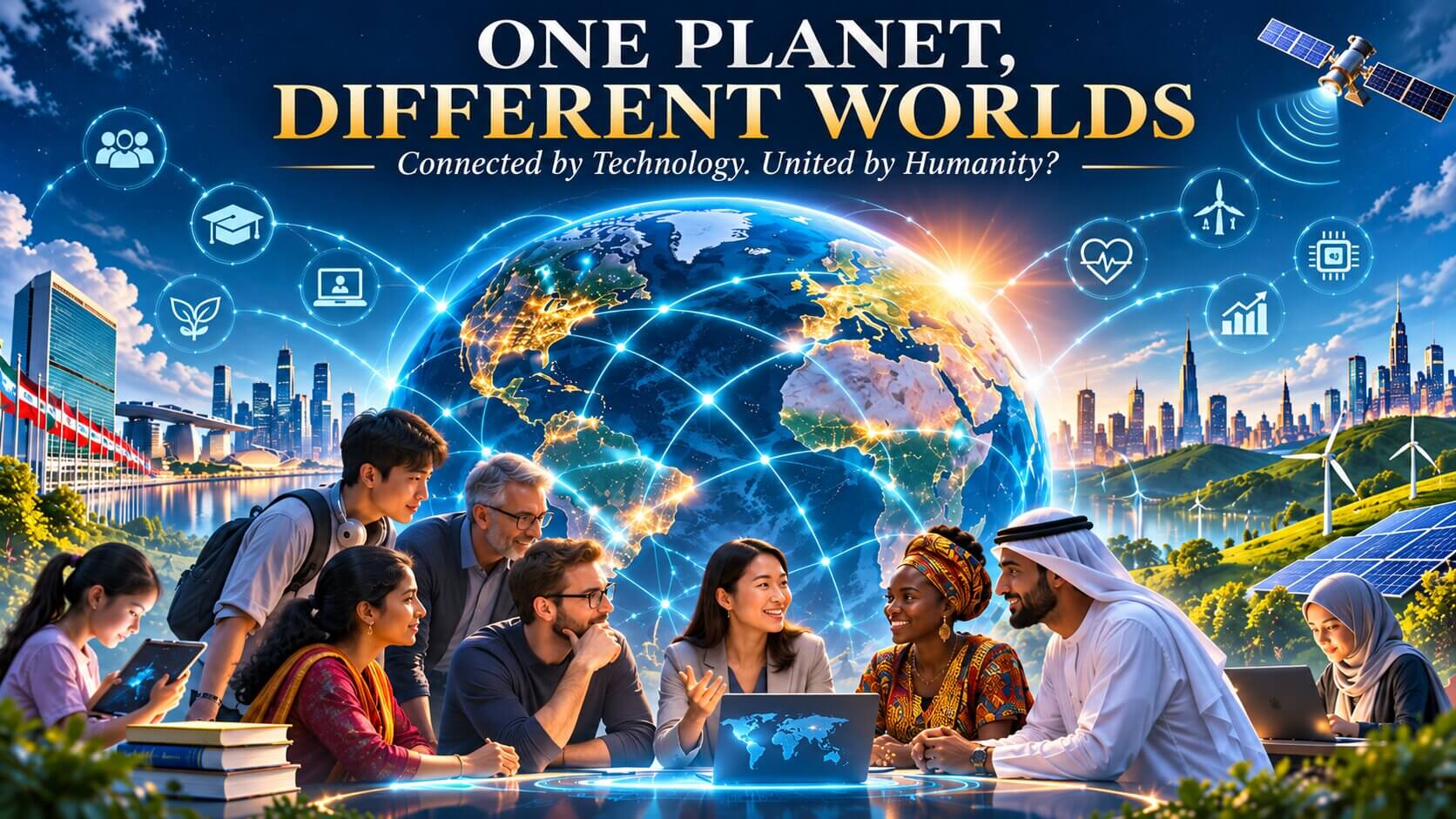
Technology has brought continents closer, but has it brought humanity closer too?
A student in Tokyo can attend an online lecture from London. An entrepreneur in India can build a business with customers in Canada. Meanwhile, a family separated by thousands of kilometres can share everyday moments through video calls.
Never before has humanity had so many ways to connect across borders.
Yet, beneath this extraordinary connectivity lies a fascinating contradiction. The world is becoming digitally interconnected while remaining divided by economic inequality, political differences and cultural misunderstandings.
Are we truly becoming a global community, or are we simply living in separate worlds connected by the same internet?
The Disappearing Distance Between Nations
Geographical distance no longer determines the limits of human interaction.
Digital platforms allow people to exchange ideas, build businesses and experience different cultures without leaving their homes.
Furthermore, international education and global workplaces are creating opportunities for cross-cultural collaboration.
A song created in South Korea can find listeners in Brazil. Similarly, a traditional Indian craft can reach customers in Europe.
The movement of ideas has become a defining characteristic of modern civilisation.
The Invisible Borders of the Digital World
Although technology connects people, it does not necessarily create understanding.
Social media can expose individuals to different perspectives. However, it can also reinforce existing beliefs through personalised content.
Two people living in the same city may experience entirely different versions of world events through their digital feeds.
Consequently, physical borders are no longer the only barriers separating communities. Digital environments can create invisible boundaries around information and opinions.
The challenge is not simply connecting more people. It is encouraging meaningful communication between them.
Globalisation and the Changing Meaning of Identity
Food, fashion, cinema and music increasingly travel across national boundaries.
A café in Paris may serve Japanese tea. Meanwhile, a restaurant in New York may introduce customers to traditional Indian cuisine.
This cultural exchange creates opportunities for creativity and mutual appreciation.
Nevertheless, globalisation also raises concerns about the preservation of local languages, traditions and cultural identities.
The future does not have to involve choosing between global citizenship and cultural heritage.
Instead, humanity can embrace international connections while protecting the diversity that makes each community unique.
Economic Inequality: The World’s Unfinished Conversation
Global connectivity has created remarkable economic opportunities. However, access to these opportunities remains uneven.
While some individuals benefit from advanced technology and international markets, others struggle to access basic digital infrastructure.
For one person, artificial intelligence may represent a new career opportunity. For another, reliable internet access remains an unmet need.
Therefore, a genuinely connected world requires more than technological innovation.
It also requires accessible education, fair economic opportunities and investment in underserved communities.
Climate Change: A Challenge Without Borders
Environmental challenges remind humanity that national boundaries cannot separate every shared risk.
Air pollution, rising temperatures, changing rainfall patterns and ocean pollution affect communities across geographical regions.
Furthermore, the environmental decisions of one country can have consequences beyond its borders.
Climate change presents an important opportunity for international cooperation.
It reminds us that despite our political, cultural and economic differences, humanity depends on the same planet.
The New Generation of Global Citizens
Young people are growing up in a world where international communication feels increasingly natural.
They can collaborate with classmates abroad, explore unfamiliar cultures and participate in global conversations.
Moreover, digital entrepreneurship and remote learning offer new ways to engage with the world.
However, global awareness must extend beyond entertainment and technology.
Understanding different histories, respecting cultural differences and developing empathy are equally important.
The next generation has an opportunity to redefine what international citizenship means.
Humanity Needs Understanding, Not Just Connectivity
The world has invested enormous resources in faster communication, smarter technology and more efficient transportation.
Nevertheless, technological progress alone cannot resolve human disagreements.
A video call can connect two people across continents, but it cannot automatically create empathy. Similarly, instant access to information does not guarantee wisdom.
Building a peaceful global society requires dialogue, cooperation and respect for different experiences.
Perhaps the most important innovation of the future will not be another digital platform. It will be humanity’s ability to understand itself.
One Planet, One Shared Responsibility
The future of humanity will be shaped by how we respond to our shared challenges.
Economic development, technological advancement and cultural exchange can bring extraordinary benefits. However, their success depends on whether they promote inclusion and mutual understanding.
The world does not need everyone to think alike. Its greatest strength may lie in learning how to coexist despite differences.
We already share one planet. The real challenge is learning how to share its future.