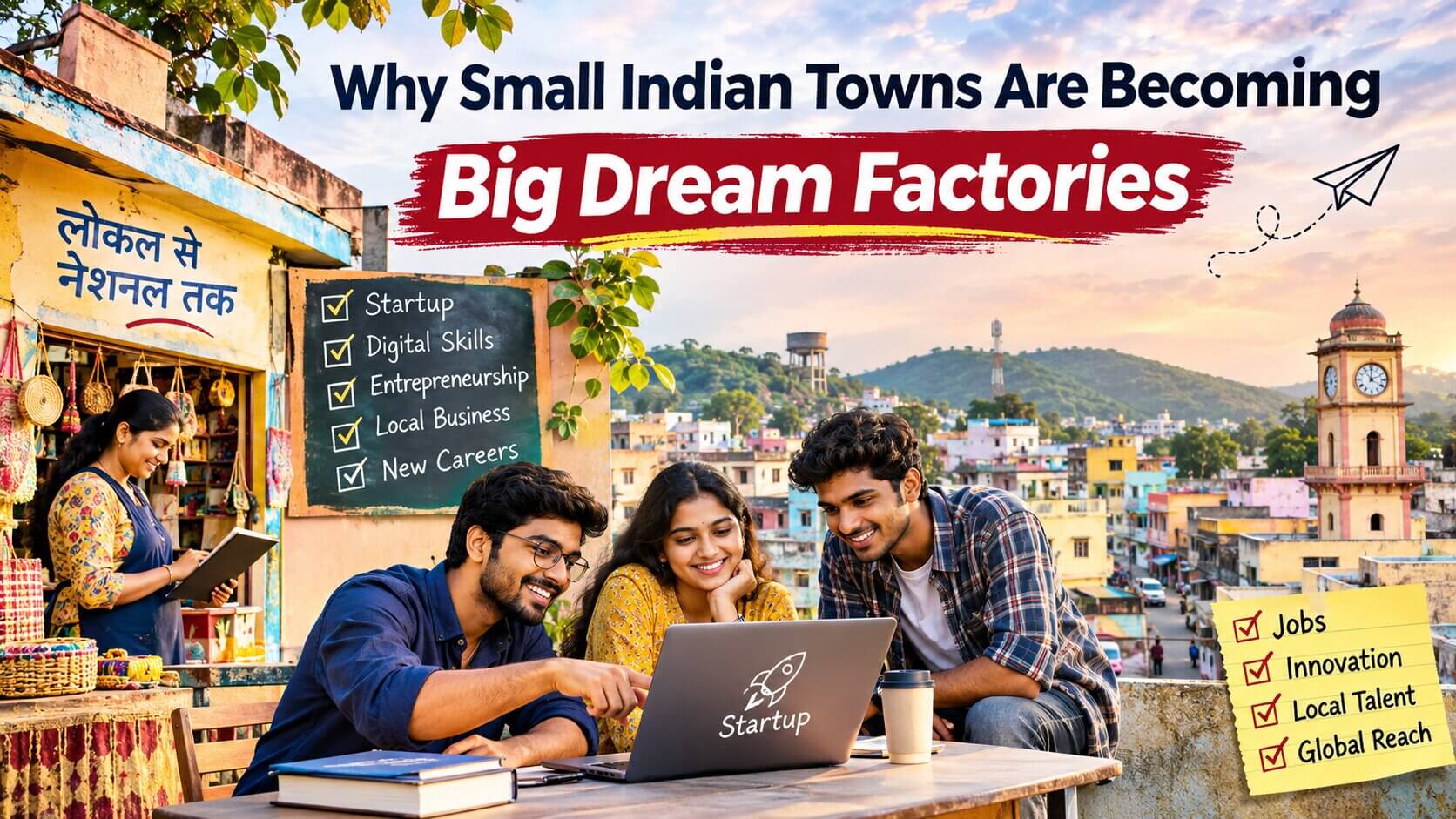
From ambitious students and young entrepreneurs to digital creators and startup founders, India’s smaller cities are quietly rewriting the story of opportunity, success and the future.
For generations, growing up in a small Indian town often came with an unwritten expectation: if you wanted to achieve something extraordinary, you would eventually have to leave.
The biggest companies were in metropolitan cities. The most attractive careers appeared to be in Bengaluru, Mumbai, Delhi or Hyderabad. Ambition often came with a railway ticket, a suitcase and the hope of finding a better future somewhere else.
But that familiar story is beginning to change.
Across India, young people are exploring opportunities that do not always require them to abandon their hometowns. Some are building digital businesses, others are learning technology skills, promoting local products, creating online content or developing services for communities they understand.
Small Indian towns are no longer simply places where dreams begin. Increasingly, they are becoming places where dreams can grow.
The Changing Meaning of a Small-Town Dream
A generation ago, success was frequently associated with leaving one’s hometown and securing a job in a major city.
That ambition has not disappeared. Metropolitan India continues to offer enormous opportunities.
What has changed is the range of possibilities available outside those metropolitan centres.
An aspiring graphic designer can build a portfolio online. A small manufacturer can explore customers beyond the local market. A student can learn programming through digital courses. An entrepreneur can test an idea without immediately opening an office in an expensive business district.
These possibilities do not guarantee success, but they are changing how young people imagine their futures.
The question is gradually shifting from “How can I leave my town?” to “What can I build from here?”
Digital India Is Changing the Geography of Opportunity
Technology is one of the important forces behind this transformation.
Smartphones, internet connectivity, digital payments, online marketplaces and remote collaboration tools have made certain kinds of work less dependent on physical location.
A local artisan can use social media to introduce traditional products to new audiences. A freelance professional can collaborate with clients in another state. A small business can experiment with digital advertising without the budget of a national brand.
For many aspiring entrepreneurs, the first workplace may be a room at home rather than a commercial office.
Yet digital access alone is not enough. Reliable connectivity, affordable devices, practical skills and customer trust are essential if online opportunities are to become sustainable livelihoods.
The digital economy has opened doors, but people still need the resources and knowledge to walk through them.
The Startup Revolution Is Moving Beyond Metropolitan India
The growing presence of startups outside major cities provides measurable evidence of this change.
According to the Department for Promotion of Industry and Internal Trade (DPIIT), India had recognised 2,50,046 startups as of October 27, 2026. Of these, 52% were located in non-metro cities.
The recognised startup ecosystem had also reported more than 25.42 lakh jobs across over 770 districts.
These figures show that India’s entrepreneurial landscape extends far beyond its traditional technology and financial centres.
Startup activity is also becoming more diverse. Opportunities range from agricultural technology and education to digital services, healthcare solutions, logistics and local manufacturing.
Some of the most promising business ideas emerge from problems that entrepreneurs have experienced personally.
A founder who understands the difficulties of local farmers, small retailers or regional-language learners may identify opportunities that are less obvious to someone unfamiliar with those communities.
This is an important advantage of hometown entrepreneurship: proximity to everyday problems can become a source of innovation.
Where Local Identity Becomes a Business Advantage
India’s smaller cities have something that cannot easily be replicated: strong regional identities.
Traditional crafts, textiles, local foods, cultural experiences and specialised manufacturing have long supported regional economies.
Digital platforms create possibilities for these businesses to reach customers beyond their immediate surroundings.
A traditional product can be introduced through storytelling, professional photography, online catalogues and social media. A local service provider can build a reputation through customer reviews and referrals.
The real opportunity is not to replace local identity with a metropolitan business model.
It is to combine traditional knowledge with modern tools.
That combination can help local enterprises remain connected to their communities while exploring larger markets.
Education, Skills and the Rise of New Career Paths
Another significant shift is taking place in how young people prepare for employment.
Degrees remain important, but practical abilities such as coding, digital marketing, data analysis, design, communication and problem-solving are becoming valuable across many sectors.
Online learning can supplement classroom education, while internships, apprenticeships and portfolio-based work offer ways to gain real experience.
India has also expanded parts of its technology support infrastructure beyond metropolitan cities.
In August 2025, the Ministry of Electronics and Information Technology reported that 60 of the country’s 68 Software Technology Parks of India (STPI) centres were located in Tier-II and Tier-III cities.
Such infrastructure can support local technology businesses and help create opportunities closer to home.
However, access to training must be matched by good teaching, mentoring and genuine employment pathways. A certificate alone cannot replace experience or marketable skills.
The Quiet Strength of Women Entrepreneurs
The changing economic landscape may also create opportunities for women who face restrictions on mobility or access to conventional workplaces.
Home-based businesses, online services, digital storefronts and community enterprises can offer different entry points into entrepreneurship.
According to DPIIT’s October 2026 figures, 48% of recognised startups had at least one woman director.
That does not mean all these businesses are women-owned or women-led. It does, however, point to the presence of women in a substantial part of the formal startup ecosystem.
For opportunity to become meaningful empowerment, women also need access to finance, training, networks, safe working environments and greater decision-making power.
The Challenges Behind the Inspiring Story
It would be misleading to suggest that every small town is becoming a thriving economic centre.
Many young people still face limited local employment, weak infrastructure, inadequate career guidance and difficulty accessing investment.
English-language barriers, uneven internet quality and shortages of experienced mentors can make professional advancement more difficult.
Remote work, too, is not available across every occupation. Manufacturing, healthcare, hospitality and many service-sector jobs require strong local ecosystems.
Moreover, smaller cities are not automatically inexpensive places to run a business. Transport costs, unreliable infrastructure and difficulties retaining skilled workers can offset lower rents.
The next stage of India’s development must therefore be about more than encouraging individuals to dream.
It must create the conditions in which those dreams have a realistic chance of succeeding.
Why the Future of India May Be Written in Smaller Cities
For years, metropolitan cities have represented India’s most visible ambitions.
Their significance will continue.
But the future may increasingly depend on expanding opportunities across a much wider geography.
Imagine an India where a talented student does not have to choose between professional growth and staying close to family.
Where a local business can reach national customers without losing its regional identity.
Where the next useful innovation emerges from a problem noticed in a small market, college classroom or neighbourhood workshop.
That future will require investment, reliable infrastructure, education, mentorship and stronger local institutions.
It will also require a different way of thinking about success.
Because India’s progress should not be measured only by how many people reach its biggest cities, but also by how many opportunities become available beyond them.
Conclusion: Big Dreams Do Not Need Big-City Addresses
Small-town India is not waiting for permission to imagine a bigger future.
Its young people are studying, experimenting, building businesses, developing skills and finding new ways to participate in the national economy.
Not every dream will become a startup. Not every idea will succeed. And not everyone will choose to remain in their hometown.
But the important change is that leaving is no longer the only imaginable path to achievement.
The next chapter of India’s growth may not begin in a glass office tower. It may begin in a modest classroom, a family workshop or a small room where someone decides that a local idea deserves a larger audience.
That is why India’s small towns deserve a place at the centre of the country’s story of ambition.
And that is why they are becoming big dream factories.
ICN National | Special Feature